Melanoma Awareness Month

May is melanoma awareness month. While melanoma is rare in comparison to other skin cancers, it can be the most dangerous.

Who is most at risk?

People exposed to UV rays (sunlight, tanning beds) can be at risk. Remember, UV rays damage the genes inside our skin cells and then skin cancer can occur. Individuals with moles can also be at an increased risk of developing melanoma. If you have lighter hair, skin, or develop freckles you may be at an increased risk. Family history can be a deciding factor. If you have a family history of melanoma you could be at risk (around 10% of individuals with melanoma have a family history of the skin cancer). The increased risk could be from genetics, shared lifestyle, or similar tendencies. If you have a personal history of melanoma, it is important to stay vigilant in getting your skin checked as you are at a risk of reoccurrence. While Melanoma occurs often in aging demographics it is not uncommon for individuals of younger age groups (think younger than 30) to occur. In America, women have a higher rate of being diagnosed with Melanoma before age 50 while male have a higher rate of being diagnosed after turning 50.

How is melanoma diagnosed?

A licensed dermatologist can use visual findings as well as biopsy results to determine a melanoma diagnosis. If a spot has changed in size, chape, or color, or is non-healing it is worth having your dermatology check it out.

Remember the ABCDE rule for skin:

  • A is for Asymmetry– One half of a mole or birthmark doesn’t match the other.
  • B is for Border– edges are irregular, ragged, notched, or blurred.
  • C is for Color– color is not the same all over and may include different shades of brown or black, sometimes with patches of pink, red, white, or blue.
  • D is for Diameter– spot is larger than 6 millimeters across (about ¼ inch – the size of a pencil eraser); melanomas can sometimes be smaller than this.
  • E is for Evolving– mole is changing in size, shape, or color.

Once diagnosed, your dermatologist will set up a time to remove the melanoma (there are various stages of the disease and treatment plans depended on how the cancer is confined and if it has spread- the cancer can be localized, regional, and distant with distant being the most dangerous and even fatal). Your dermatologist will come up with an individualized care plan for you and your skin cancer recovery,

Where can melanoma occur?

Potentially, melanoma could occur anywhere but it is common to find it on body parts like the trunk area. It can also be found on facial parts, bottoms of feet, and even under fingernails. Again, there is great important in getting annual skin exams done by your trusted dermatologist.

Can melanoma be prevented?

It’s worth a try! Avoid using tanning beds and when out in the sun seek shade and SPF. For sunscreen protection consider a mineral sunscreen with a minimum of SPF 30. Pack a hat or sunglasses for hot and sunny days. Keep an eye on moles that appear abnormal or begin to change appearance.

Monitor your skin regularly and don’t forget to schedule your annual skin exam with your dermatologist to rule out any potential abnormalities.

(Sources from this blog and for more information and resources on melanoma and other skin cancers can be found here: https://www.cancer.org/cancer/types/skin-cancer.html )

Patient Centered Dermatology Care

It is no secret that as we age our medical needs rise. It’s also no secret that healthcare can be a very complex and expensive part of our lives. At Statewide Dermatology, our goal is to not only provide excellent and compassionate clinical care, but to simplify our partners and patients’ healthcare experience as much as possible.

You need us? We’re there! Our mobile business model allows us to see patients within days of a requested visit through in person visits or same day telemedicine visits.

For facilities, our services offer a relief in logistical planning and at no added cost. Facilities can save time and money by having Statewide Dermatology conduct visits onsite instead of having to arrange regular off-site appointments; patients can be evaluated and treated in the comfort of their own home. Off-site visits are occasionally needed for our patients who require invasive procedures*.

Have questions? Have urgent needs? Our partnering facilities have 24/7 access to our dermatology resources and all calls and emails afterhours are answered within 24 hours- on weekends too!

We know our patients too! Nearing a decade of practice in the State of Florida we know a thing or two about serving our patients. Our primary focus is on our patients in skilled nursing facilities, assisted living facilities, and independent living communities and ensuring their skin health is managed properly.

If you are in need of regular or occasional dermatology care, please contact us for more information. We would love to ensure you and your residents have the best dermatology services available.

Is it Scabies?

Human scabies is one of the most common dermatological conditions in the world with over 200 million individuals impacted by the condition at any given time.

What is scabies?

Scabies is a parasitic infection caused by very small mites who burrow in human skin. Scabies may become a complicated situation and end in bacterial infections amongst other serious health conditions for the parasites host. Mites burrow in the top two layers of skin and lay eggs and the eggs then hatch within days. Patients typically present with an intense itch or rash within four weeks of the mites infesting their skin.

What are the symptoms of scabies?

The most common symptom of scabies is itch or intense itch known as pruritis. The itch is caused by an allergic reaction in the body to the mites and their fecal matter. The itching can occur at any location on the body, but most common locations range from fingers, wrists, elbows, genitals, buttocks, breasts, back, waist, and shoulder blades. Sometimes a rash may be present or a pimple like growth. Usually, the mites are not seen by the naked eye although their tunnels can be seen occasionally on the human body. Usually there are no more than 10-15 mites on a host at any given time.

How is scabies diagnosed?

Scabies is generally diagnosed via presentation of itch and rash and/or the presence of any burrows. Skin scrapings are often done to help diagnose scabies but many times the mites have left their host by the time symptoms are evaluated so skin scrapings can be inconclusive. Scabies is highly contagious and hygiene and treatment of others who have likely been exposed can be extremely beneficial in controlling an outbreak.

How is scabies treated?

Scabies is treated with a topical scabicide like 5% permethrin. Oral ivermectin is also efficient in treating the condition. The itch may intensify during treatment but should resolve after 1- 2 weeks. Sometimes treatment may need to be repeated to be effective and often times this includes treating all exposed parties.

Who is at risk most for scabies?

Young children and the elderly are at the highest risk for scabies and complications like infections. Individuals who live in group homes or in a shared community setting are also more commonly at risk of exposure due to close proximity of living spaces and shared everyday items like furniture since the mites can spread via contact of human skin or things like clothing and furniture. Individuals may not know they have scabies due to being asymptomatic for 4-8 weeks and scabies can spread to others during this time.

How to be proactive in regard to scabies:

While scabies can infest people and things well before symptoms arise it can be hard to 100% prevent them. The most important thing anyone can do if he or she has an ongoing itch or rash is to call your dermatologist for evaluation. During this time practice good hygiene by cleaning your home and washing your laundry and clothing regularly and with hot water and hot dryer cycles.

I think I have scabies. What do I do now?

If you live in a group home let your administrator or nurse manager know immediately and ensure your dermatologist is called and available for evaluations as soon as possible. Your dermatology provider will need to evaluate your skin and symptoms and if scabies is suspected and/or confirmed your scabies treatment will begin immediately. This will likely include a topical prescription like permethrin and a possible prescription of Ivermectin. Your provider will ensure your care plan is acceptable for your personal health needs. There is a good chance your roommates or individuals you share a home with will need to be evaluated and treated as well. Sometimes patients must be treated more than once to relieve the condition. When possible, thoroughly sanitize your space. If you live in a group home your site managers will need to help sanitize your space and any shared spaces to ensure the outbreak is being controlled.

Scabies is a contagious condition that can be a real itchy situation. If you are experiencing itch or pain, it is very important you contact your dermatologist for a skin evaluation.

Want to learn even more about scabies? Visit the sites below:

https://www.cdc.gov/parasites/scabies/index.html

https://www.who.int/news-room/fact-sheets/detail/scabies

What you need to know about UVs

Living in the sunshine state there is no shortage of sunshine or activities to participate in outside. It is important from an early age that proper care of our skin is maintained to protect ourselves from the dangers of skin cancer. While our body needs vitamin D and the sunshine is a great source of that (as well as nutrients and supplements), any elongated exposure to UV rays requires some kind of skin protectant to mitigate risk of sun damage.

Ultraviolet radiation (UVs) is a kind of electromagnetic radiation that can come from the sun or even man made items like tanning beds. Energy from the the radiating source can give off varying levels of energy. The highest energy is called ionizing radiation and this particular kind of energy can damage our DNA and in turn cause skin cancer.

There are three main groups of UVs (1) UVA rays: have the lowest energy and can cause wrinkles of the skin, skin spots, and other more cosmetic long term effects to skin (2) UVB rays: have a medium level of energy (slightly more than UVB) and are thought to be prevalent in causing skin cancers. UVBs are the main source of sun burns. (3) UVC rays: Highest level of energy but they react higher in the ozone atmosphere and typically do not reach the ground level. There are man made products (bulbs, welding tools, and other sources) than give off UVCs. UVCs are not associated commonly with skin cancer cases or skin damage.

Sunshine is the main way people are exposed to UVs. It is important to monitor UV levels if you plan to spend extended amounts of time outside. Now there are numerous weather sites to monitor UVs daily to ensure you are prepared. Other things to consider: what time of day you are outside, how long you will be outside for, what time of year is it, what is your distance from the equator, what altitude are you at, and is there cloud coverage (amongst other things). If you can’t avoid being in the sun during high levels of UV ensure you wear proper sun protection (minimum of 30 SPF, sunglasses, and a hat) and seek shade when you can.

Indoor tanning is a prominent way individuals are exposed to UVs. Some beds emit UVBs and some emit UVAs. It is best to avoid tanning beds as they are associated with increased melanoma, squamous and basal cell cancers.

Since UV rays from sun exposure and certain indoor exposures are most certainly tied to skin conditions and cancers it is important you remain vigilant in monitoring your exposures and taking preventative measures to protect your skin health. If you live in a state like Florida with a lot of direct sunlight ,daily SPF use is recommended. And as always, don’t forget to schedule your annual skin check with your dermatologist. It is important to have a specialist check your skin and and any concerning changes to your skin.

UV indexes are widely available, you can check sites like : https://www.uvindextoday.com/usa/florida/hillsborough-county/tampa-uv-index for daily information. Your favorite weather channel offers UV index information as well.

For more information on UVs you can also visit: https://www.cancer.org/cancer/cancer-causes/radiation-exposure/uv-radiation.html

(Sources, American Cancer Society).

Happy New Year

Happy New Year to all of our patients and facilities.

Statewide Dermatology wishes you and your loved ones a happy and healthy New Year. We are here for you and your skin care needs during these unprecedented times. We thank all of our partners, sites, and patients for counting on us to keep our community members’ skin in optimal condition. We ended the 2021 New Year strong and we look forward to another wonderful year of being the travel dermatology team you can count on for clinical excellence, reliable service, and compassionate care.

With a new year comes a new need to book your annual skin checks. Please consider contacting our office at 813-749-6907 to book your skin check or your site’s skin checks. Skin checks are a great way to get ahead of chronic skin conditions that impact aging demographics and also a great way to screen for potential Skin Cancers. For more information on why skin checks are valuable please download our handout here:

We look forward to serving you and your community in 2022.

Healthy Skin During The Holidays

Preventative measures are often key to staying in good health. The same goes for your largest organ, your skin! Your skin is made up of three layers: the epidermis, dermis, and hypodermis. Your skin has many functions as it may act like a barrier (from water, UV light, etc.), it helps balance your bodies temperatures, and it plays a role in the production of certain vitamins (like Vitamin D).

During certain times of year (and depending on your specific skin type) your skin’s needs may change. For example, during cooler winter months with less humidity you may notice your skin feeling dull, dry, and even irritated. To avoid the dull and irritated skin cooler weather can bring upon us, keep up with a regular moisturizer routine. Play close attention to your hands and extremities. We typically recommend using a lotion that is unscented or lightly scented for those who have sensitive skin. Quality over-the-counter moisturizers can be found at all convenience stores and grocery locations at varying costs. If you have been following a regular moisturizer routine and you are not getting the relief you need it’s probably time you reach out to your dermatology care team. Other tips we recommend to help protect your skin this fall and winter: (1) Never forget your SPF! Just because it’s cold out doesn’t mean you can’t get a sunburn. UV rays are strong (sometimes stronger) during Winter months. (2) Be aware of when you are using your heater inside and if it is drying your skin out. Keep your moisturizer close! (3) Hot water can really dry out your skin. If you are taking a lot of hot baths, showers, or dips in the Jacuzzi follow up with a good lotion or reduce the temperature from “hot” to “warm” when bathing . (4) Don’t forget your lips! Keep your lips healthy by using a lip balm or other appropriate protectant from cold winter days and SPF from the sun. (5) If your in extreme cold, consider hats and gloves to provide extra protection to your scalp, ears, and hands.

Happy holidays and cheers to healthy skin!

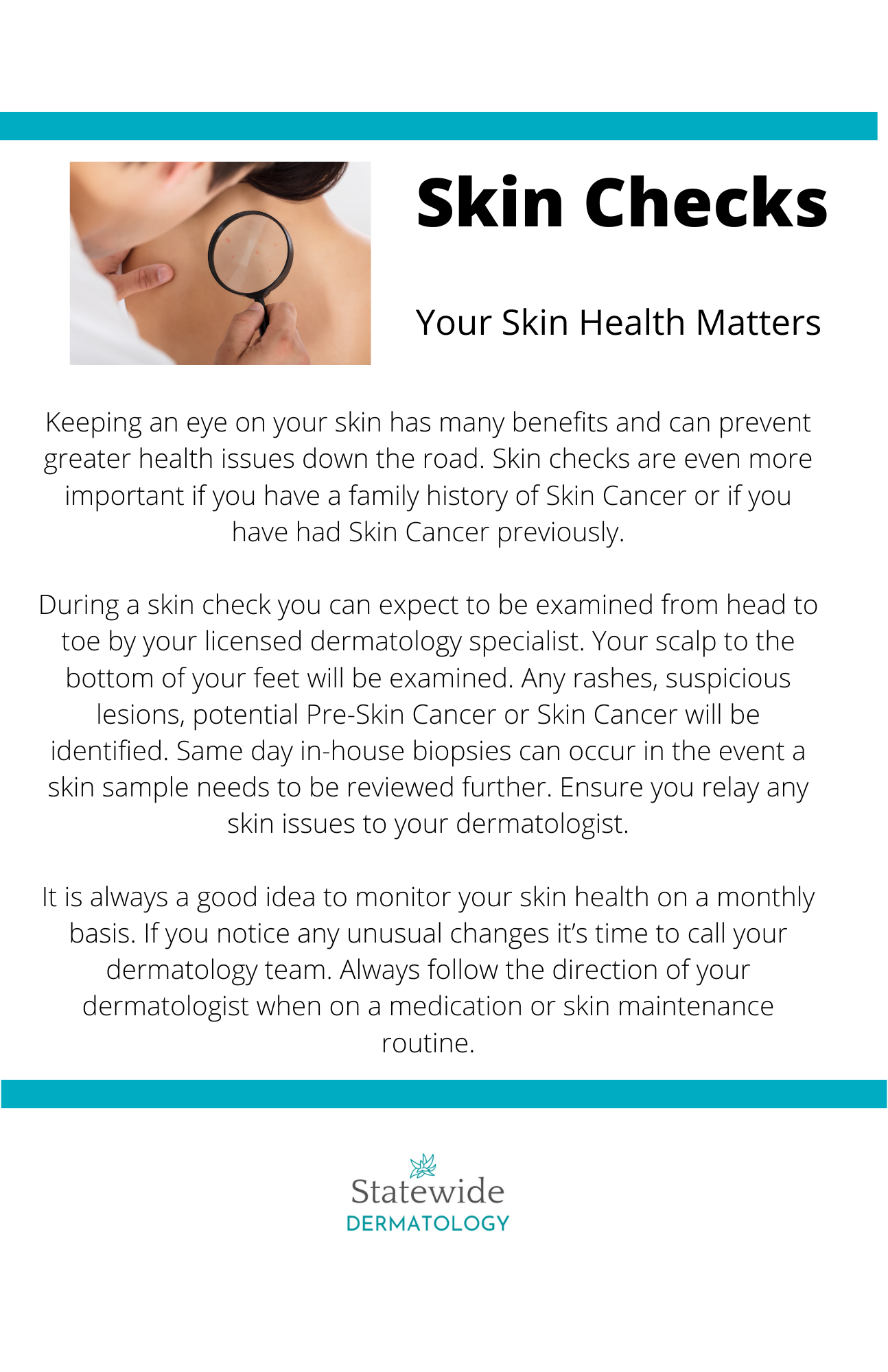
Why Are Skin Checks Important?

Keeping a close eye on your skin health has many benefits and can prevent greater health issues down the road. Skin checks are even more important if you have a family history of Skin Cancer or if you have previously been diagnosed with Skin Cancer.

During a skin check you can expect to be examined from head to toe by your licensed dermatology specialist. Any rashes, suspicious growths or lesions, or changes in appearance of skin will be examined. Same day in-house biopsies can occur if medically necessary. Always ensure you relay any skin issues or skin changes to your dermatology provider. After your skin exam your provider will work with you and your care team to come up with a skin care and maintenance plan should you need one. This could include routine moisture application counseling or biopsies and treatment of pre-cancerous cells.

It is always a good idea to monitor your skin health on a monthly basis. If you notice any unusual changes it is likely a good time to call your dermatology care team.